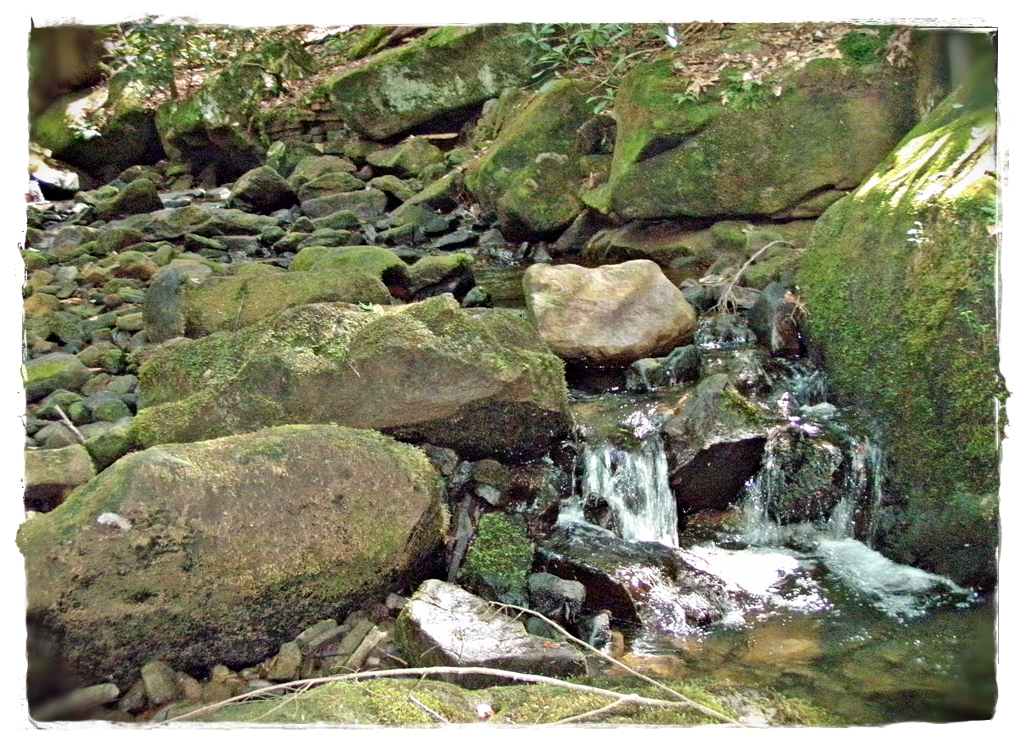

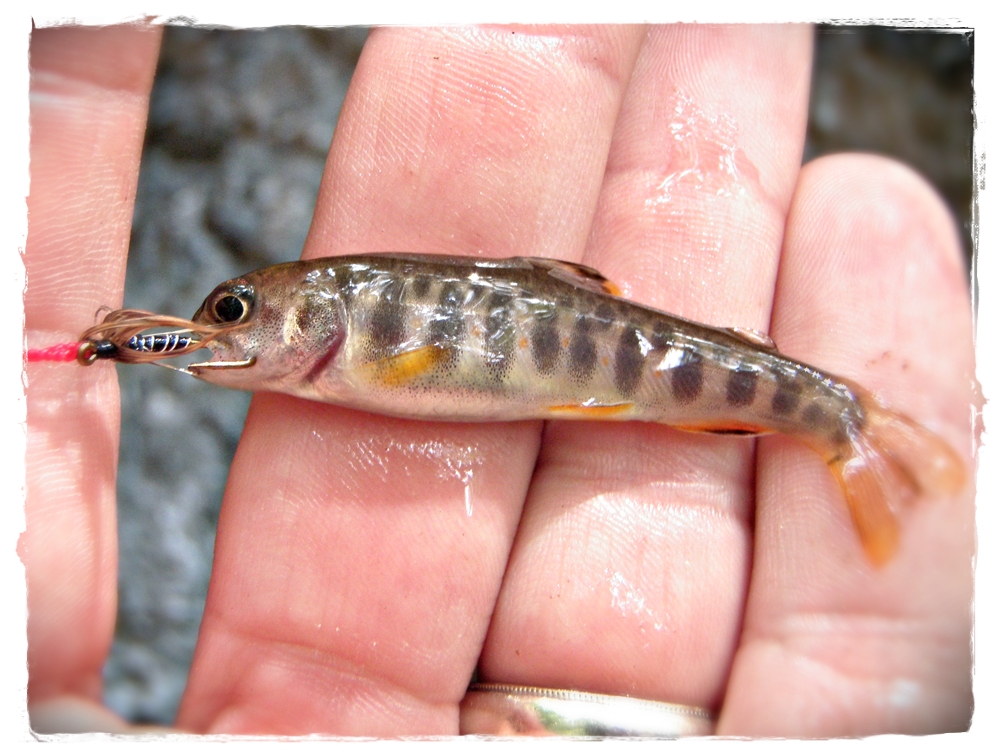
When I say small stream here – I’m talking small. Not small compared to a river but small compared to a small stream. This tiny stream is tucked into a rhododendron choked valley. Are the fish that it contains native strain brook trout unpolluted by our hatcheries? Probably not – but I don’t know. Defying non-existence they exist. Whether or not I fish for them they hatch, swim, spawn, die. By fishing for them I give them meaning and they give me meaning. As sweat trickles down my brow from under the brim of my hat and burns my eyes, as I (for the hundredth time) untangle the line from a branch, as I miss that subtle and lightening quick strike, as I worry about rattlers, as the stream enslaved by gravity tumbles toward union and oblivion with the river, I slowly merge into the shadowy green-ness – into a quiet “un-ness”, I complete an arabesque into sweet nothing. It can take a while, but eventually (hopefully) the million small frustrations of fly fishing a small, brushy stream will allow the shift from “going fishing” to just “being”. Forgetting the self. That is my goal. To put a strip of duct tape over that relentless internal dialog and to silence it. To move from thinking in words to thinking in actions.
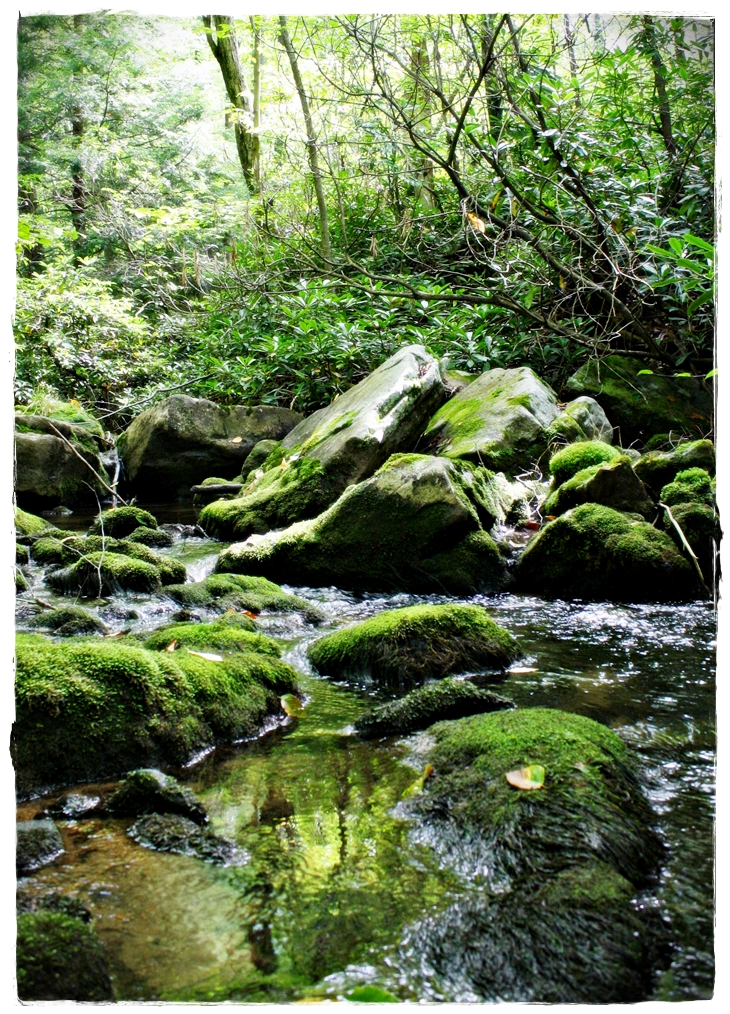
The small brushy stream holds challenges for the fly fisher and the tenkara angler. Because of the longer rod – maybe more challenges for the tenkara angler. Those overhanging trees and rhododendron make casting and hook-setting very difficult. There is very rarely any place to backcast. And if you attempt to set the hook with a little too much gusto – it doesn’t take much – you will find your line, your fly and maybe your rod-tip tangled overhead.
So how do you overcome these problems? Think small. Short rods and short lines. I have two short rod options. A 7′-8″ Daiwa Soyokaze that I bought from www.tenkarabum.com, and a Tenkara USA Iwana with the short handle (making it come in at a little over 9′ long). The Daiwa has a softer tip than the Iwana. This is good and bad. The softer tip loads with a very light line. When you have room to backcast – casting a #2 fluorocarbon line is no problem at all. The light line makes for very delicate presentations – which on these small streams is paramount. But the trade-off is in the hookset. The soft tip can make hook-setting a little more difficult. I think the Iwana has the edge when it comes to setting the hook. Obviously the rod length can be an issue too, with its own tradeoffs. The shorter Soyokaze makes casting a bit easier – but you lose the reach of the longer rod. For the smallest brushiest streams, I’ll go with the short rod. If the stream is a bit more open then maybe the longer rod. The short line goes without saying. I want the line, plus tippet to be a little shorter than the rod. Not only is a short line much more manageable in the brush, but it makes the bow-and-arrow cast possible.
What about casting? Well on this particular stream I’d say 90% of the casting was bow-and-arrow casting. In case you are unfamiliar, the bow-and-arrow cast is done by grasping the fly at the hook bend, pulling back to bend the rod, aim the the rod at the target, and release. This cast is crucial on small brushy streams because it allows you to cast into tight spaces without a backcast. And after some practice you can get pretty accurate with this cast. The overall length of line+tippet is crucial. You’ll find that you’ll want that total length to be just a bit shorter than the rod length. If it’s too long you won’t be able to pull the fly back far enough to load the rod for casting. Too short and it’s difficult to reach the fly without choking up on the rod or setting it down behind you.
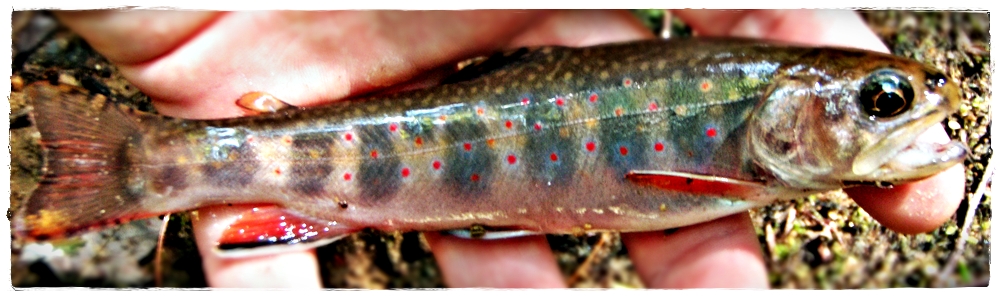
What about hook setting? When you’re under low hanging branches you’ll find hook setting a problem. A flick of the wrist, and if you miss the fish, you’ll often find your fly and your line hopelessly tangled in the snarling branches above you. Sometimes the fish hook themselves, but often they spit the fly out. For example on this day, I’d bow-and-arrow cast the fly to a tiny pool or riffle, begin a dead-drift, and the line would dodge or stop, I’d try to set the hook gently – invariably it would be too late and end up in the trees. I’d try to let them hook themselves by applying just a gentle pressure to the rod when I had a strike – but these were pretty small fish, and they would not hook themselves that way. So I went to plan C. What worked for me was this; I’d cast and when the fly hit the water I’d begin making small pulses – almost jigging the fly, kind of like a bunch of small preemptive strikes. It worked. And it worked well. I finally began hooking fish and not hooking overhanging branches. Getting the fly moving a little seemed to be just the ticket to getting positive hook-sets.
It may go without saying but stealth is crucial. These fish are not picky. They will try to eat just about any fly that will fit in their mouths. But they are spooky. You need to be sneaky. Walk slowly, avoid wading if at all possible, cast no shadows on the water, don’t shake the overhead branches, don’t let your line slap on the water and watch the tail of the pool. This can take a lot of patience and focus. But you will not catch fish if you spook them. There is no long distance casting on a stream like this – you are going to have to get close. If you’re fishing a small mountain stream like this, that you know has fish, and you’re not getting strikes then you’re not being stealthy enough. The toughest approaches on this stream were the larger pools. Often a fish would be sitting in the skinny water just at the tail end of the pool. In spite of my best efforts these fish were very difficult to fish to without spooking. Getting close enough was a big problem,and then casting too was an issue. If anything more than the fly hit the water – they were gone. Even the light #2 level line was plenty to spook them. The heads of the pools offered a nice bit of broken water making the approach much easier.
The fish are small – there is no glory of big fish here. There is no hatch-matching. There is no technical midge fishing. It is a different set of challenges, but this is perhaps some of the toughest fishing I do. On these tiny, brushy streams, I feel like I work harder for fish than just about anywhere.



 Casting Around
Leave a reply to TJ Ferreira Cancel reply