
If you have paid any attention to any tenkara discussions you have probably noticed the idea of “one-fly” coming up. Very simply put the idea of “one-fly” fishing is to use basically one fly pattern for all of your fishing – no hatch matching, no changing flies for that deep pool, etc. This method of fishing then is focused on presentation and not fly pattern. And though it is often posed by tenkara anglers these days, the idea of “one-fly” is certainly not unique to tenkara. I imagine there are plenty of old-timers that would scratch their head at this idea as being an “idea” at all. What I mean is prior to the explosion of match the hatch, and even now, there are plenty of folks that fish with a very simple fly selection – perhaps not limiting it to one fly – but three or four patterns anyway, it’s not any “idea” it’s just the way they fish. I can recall times (though not that often) when I watched some old-timer work his way along the stream with a wet-fly swing, regardless of anything else. He was just fishing his wet-fly. No fly switching – just one-fly. When I read Paul Arnold’s book The Wisdom of the Guides – one idea that the fly fishing guides mentioned over and over was the idea of good presentation being more important than fly selection. That is – keep your fly selection simple and focus on technique. This has become a sort of tenkara mantra – though tenkara doesn’t own it. And so I come to the idea of a using one-fly for all of my fishing through tenkara – but it is not something that need be limited to tenkara.
So why do a “one-fly” season? I’d like to say from the get go that this is not about proving anything, tenkara-related or otherwise. I am not really interested in saying that “one-fly” is better than hatch-matching – I think that that line of reasoning is misguided. It is all about fishing in a way that an individual finds enjoyable right? So if someone enjoys hatch-matching, and all that goes with it that is cool with me – I like that too. I have never been a person to compare tenkara and western fly fishing to each other with the goal of declaring a “winner”. They are both fun – they are similar in some ways – and they are different in others – there are pros and cons to each – and in the end it comes down to what floats your boat. I have fished tenkara almost exclusively for my trout fishing and done so with a very simple fly selection the last three seasons, not quite one-fly – but pretty simple usually, especially the past two years. And I have done at least as well as I have ever done. I make no claims at being an expert – or even “accomplished” – so any success is merely based on my own standards. I have not noticed any drop-off in fish catching, and though I haven’t really recorded it – I think I am doing better by keeping it simple. As I get older, and presumably wiser, I realize that I know less than I thought I knew. In fact the idea of knowing facts has become less important to me than understanding things intuitively. Facts and reasons have become somewhat slippery in a way – they don’t seem to contain as much information as I once thought. So the facts and reasons of why to do a one-fly season are elusive to me and maybe illusory. There have been studies done that seem to show that we may have less free-will than we think we do, that we decide to do something before we realize it. I think there’s something to that. I think that often we, or at least I, act first and then come up with the reasons later. So the shortest and best answer as to “why?” is “just because”.
Even though I make no great claims about why I am doing it – I am still interested in what I may learn by doing it. I think that there is potentially a lot to learn by limiting yourself. It is discipline. So maybe at the end of my one-fly season I will have realized some truth about myself and my fishing, or maybe I will have become a better more intuitive angler, or maybe it will be a complete frustration. However it pans out – I will know something new.
Let me add that I do most of my trout fishing in small to medium sized streams, and I have always preferred fishing pocket water and riffles as opposed to deep slow pools. So the small unweighted wet fly fits in with my fishing nicely, it is not a big stretch.
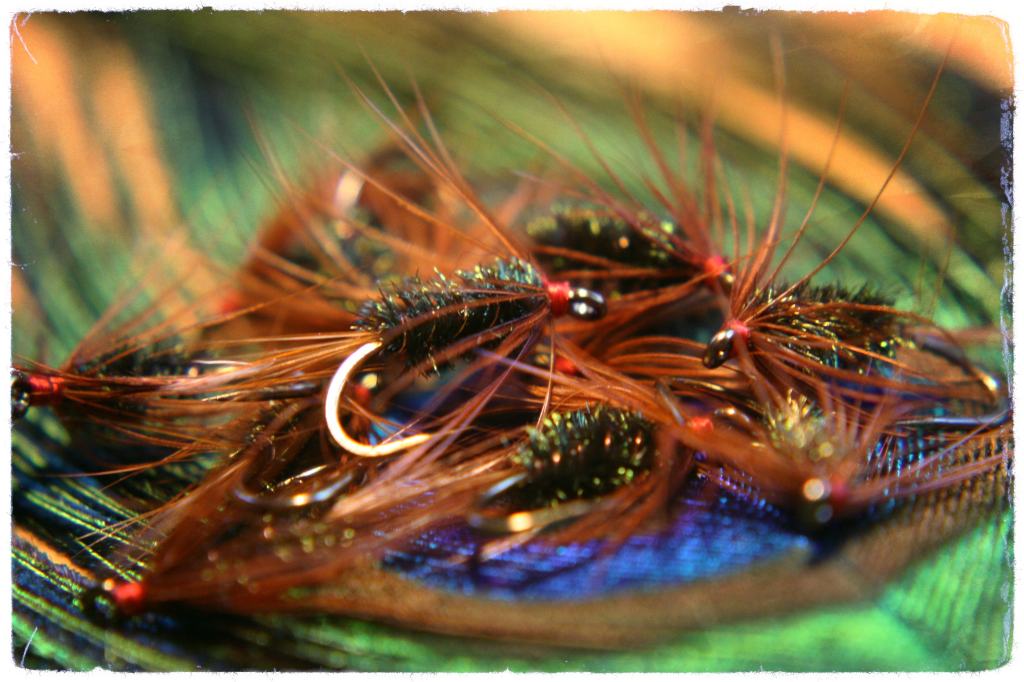
The rules. I guess I should set out a few rules. I am not going to limit myself to one exact fly recipe – but rather to a general pattern. The basic pattern will be based on the Brown Hackle Peacock fly shown above. But, just to keep things a little loose – I’ll mix it up a bit. I’ll change hackle type and hook type and size, throw some loop eye flies in to the mix, some reverse hackles. But none of these changes are meant to match conditions or bugs – just meant to keep it interesting. So basically the fly will be a soft-hackled, peacock body wet-fly. I will not use added weight or bead heads. That’s it.
The one fly season has begun. I’ve managed to get out twice this year as of this writing. So below I present reports from the two trips so far.
One-Fly Season Day 1: March 9, 2013
 First trip of 2013. The weather was nice. Upper 40’s , snow on the ground, but melting. This particular stream is very small – no large holes and not a very high gradient, also quite brushy, with plenty of low hanging trees, fly-hungry trees. As you see in the picture – the flow was fairly low. This stream is not typified by large deep plunge pools. The low-gradient, small free-stone, structure creates occasional small plunges with shallow, long pools. In between there are shallow runs with small pockets. These types of small mountain streams can be pretty difficult. The fish aren’t particularly selective – but they are extremely spooky. And those long smooth and shallow pools can make presentation tricky. One flubbed cast to the tail of that pool and you’ll send fish scattering up though the rest of the pool spooking anything else in there. This is a case when long tenkara rod and a light tenkara level-line is very helpful. Very delicate casts can be made with very little line hitting the water, while remaining at a safe distance.
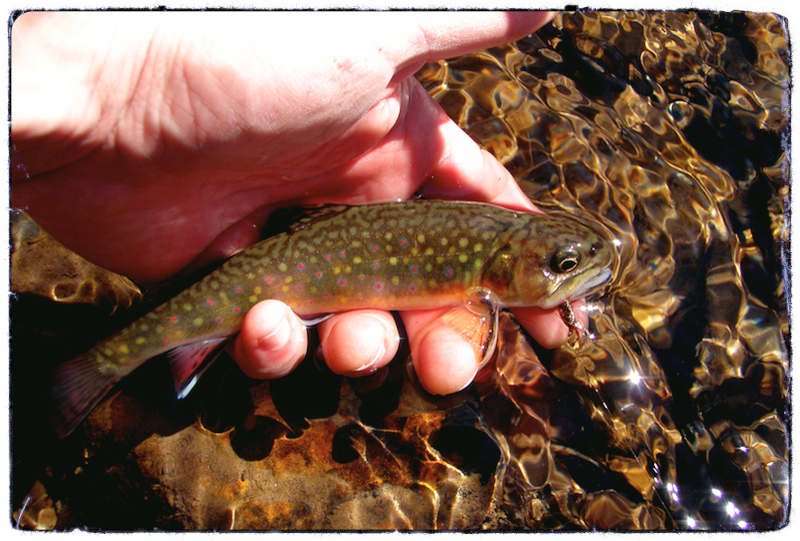
Being the first trip – I was a little clumsy at first. It took a while to get back in fishing form. I was like a clumsy bear, emerging from hibernation hungry. I was hungry to catch fish. And too anxious. I had to tell myself to slow it down. I had a hit right away – but then nothing for a while. Finally though I got my groove on and picked up a few fish. Not great numbers, but enough to keep me happy. Actually one fish would have been enough.
I got the first hit on a size 12 peacock fly with hen pheasant hackle, but then nothing for a while. In the past I surely would have tied on a different fly but I stuck with it until I lost it high in a tree. Next we went to a size 16 Brown Hackle Peacock like the one in the top picture. Several fish came to hand right away. Ahh! I thought it was size! The fish wanted a smaller fly. However, after 3 fish I lost the size 16 in a tree. So I switched to a large reverse hackle (sakasa) fly tied on a blue Japanese bait fishing hook and finished with a red loop-eye. Third cast – bam! A fish came up to the top and smacked the fly before it even had a chance to sink. Of course I lost this fly in a few casts.
What did I learn? It’s too early to draw too many conclusions, and these were wild brookies – not exactly discriminating fish usually. But in the past I probably would have called the size 16 the best fly for the day and stuck with a smaller fly – however on this day – I tied on the next fly in the box which happened to be a much bigger, and slightly different version, and got a fish right away. Not exactly a scientific study – but also maybe not what I expected.

One-Fly Season Day 2: March 15, 2013

Well day two was pretty similar to day one – small stream, snow on the ground, very cold water. The stream was a slightly different kind of stream though. In general a bigger stream, higher canopy (more open casting room), a higher gradient, bigger in-stream rocks and boulders making bigger deeper pools and more nice pockets. I must emphasize that the water was really cold – I didn’t take a temperature reading but it was the kind of cold that makes a dipped hand ache instantly. I wasn’t expecting too much action with the cold water.
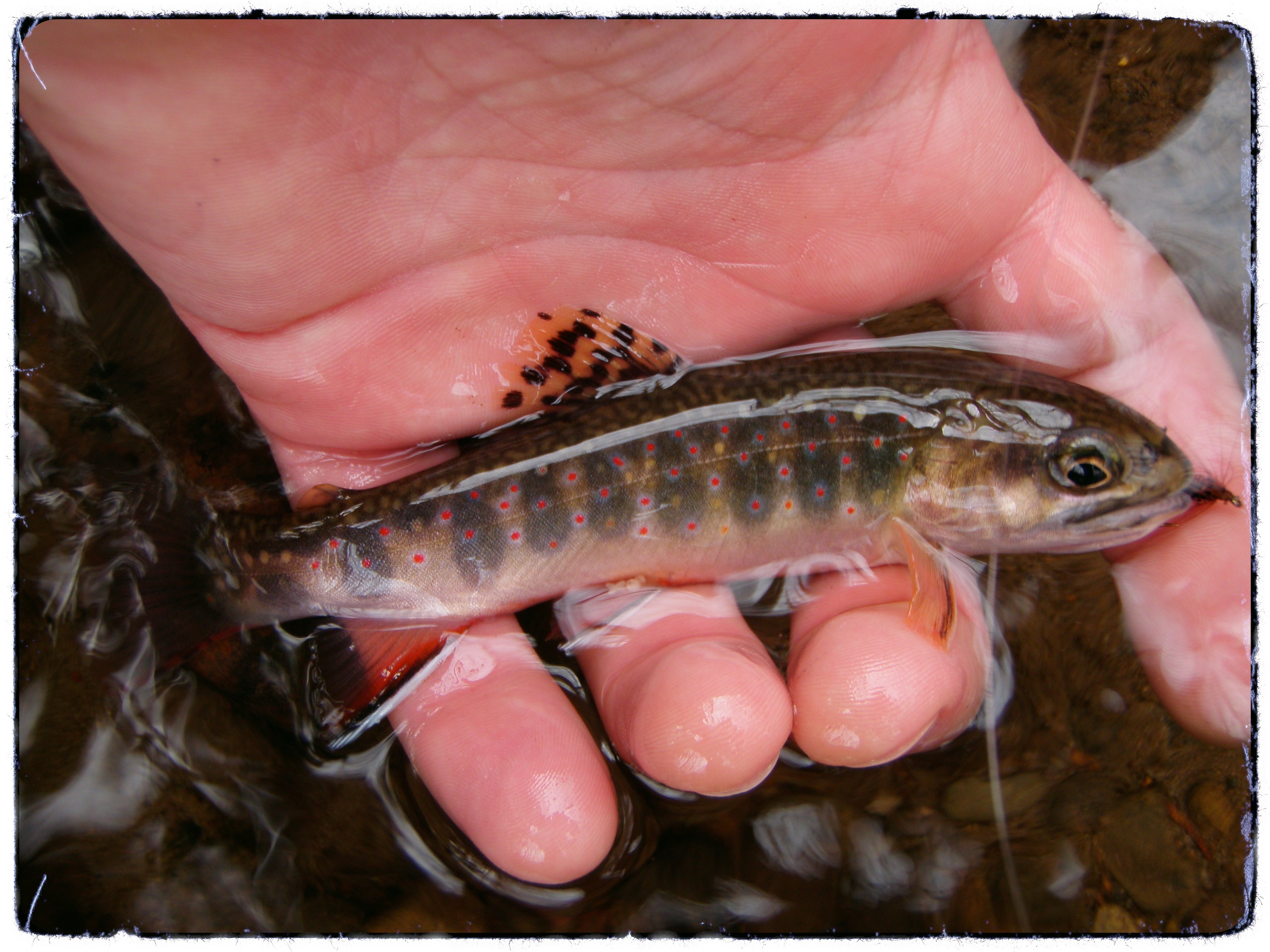
 I tied on a size 14 Brown Hackle Peacock (as shown in pic at the beginning of the post). I figure I’d try the pockets for a while, just for the heck of it. Nothing. The fish didn’t seem to be hanging in the pockets yet – so on to the bigger slower pools. And that was the ticket. This stream, even though it is small, forms some nice deep pools. I skipped the deepest of these and focused on pools that I could fish more easily with my unweighted fly. I don’t remember exactly, but I think 5 or 6 fish came to hand. All were small wild brookies.
Did I learn anything? I think so. In the past I would have very likely tied on a small bead head fly – or added some split-shot to get deeper into those big pools. But it turns out that it wasn’t necessary. Perhaps I could have caught more fish if I had done so – but I caught enough to keep me happy. And because I wasn’t fiddling with changing flies and adding weight and taking weight off – and because I was focused on a certain type of water, I moved more quickly and got to see more of this new-to-me stream than I would have otherwise. I am looking forward to getting back on this water when the water warms a bit and the fish are more active – it should be good fun.
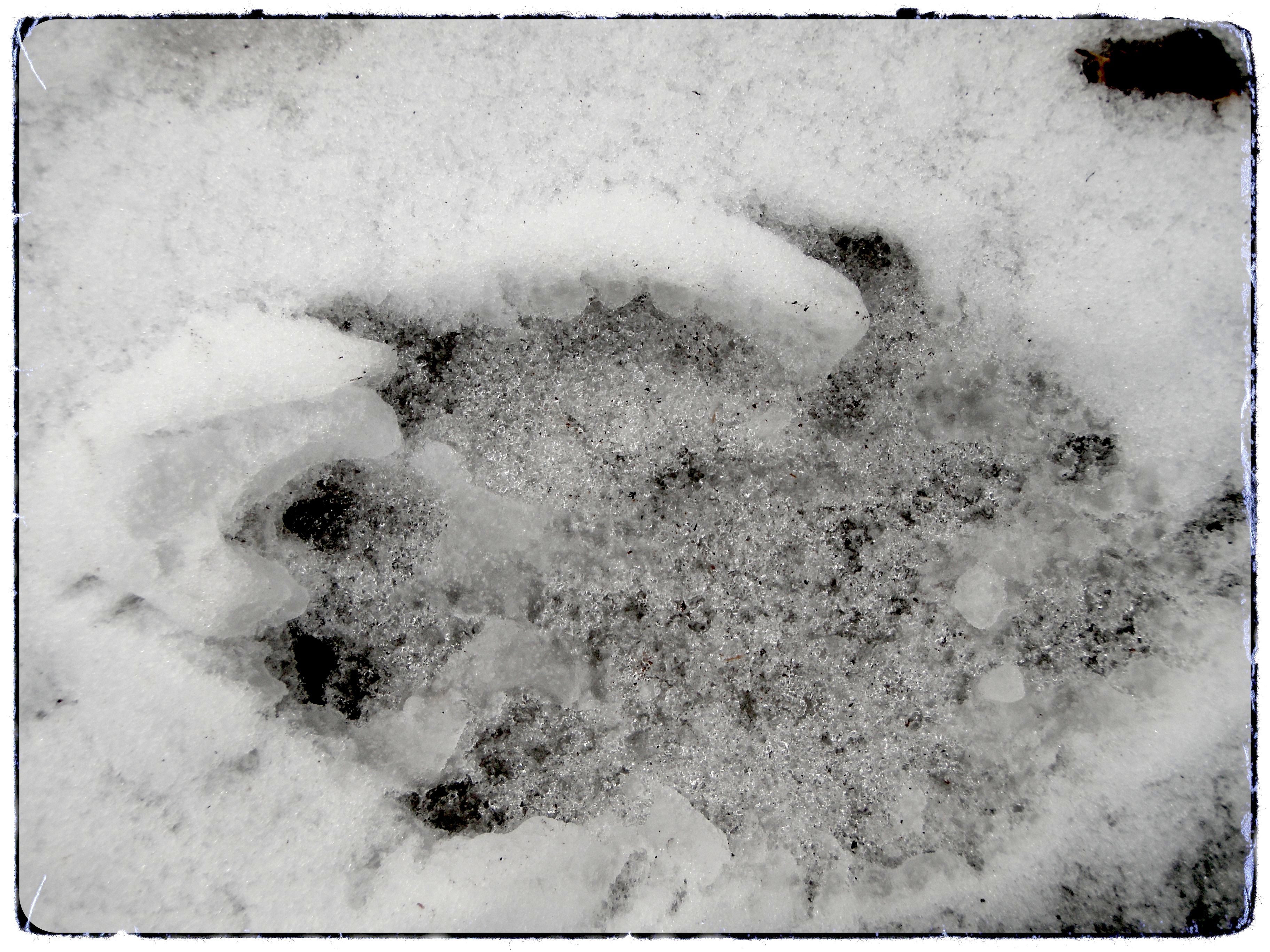
On the way out I came across some bear tracks – which weren’t there on the way in. There was a big set and at least one small set – so a mama with a cub or two. Pretty cool and a nice way to end the day, following bear tracks back to the car. Apparently I am not the only one in these woods anxious for spring.



 Casting Around
Leave a reply to Gerardo García Cancel reply