
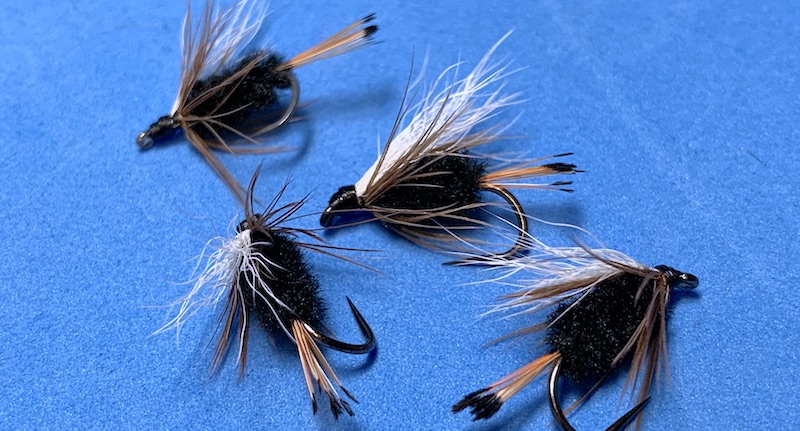
As I attempt to bring Casting Around back to life I am feeling nostalgic. One of my early posts (in April 2009) was about the Pass Lake Wet Fly. But since that post I have used the Pass Lake more and more and have come to rely on it as a primary tool for my fishing and I think it is worth revisiting.
If I had to choose one wet fly the Pass Lake would be the one. IT PLAIN WORKS.
If you dig around online you’ll find various origin stories for the Pass Lake. Some say it came from Canada some say Wisconsin or even Washington. In his book Upper Midwest Flies That Catch Trout and How to Fish Them: Year-Round Guide, Ross A. Mueller states that the Pass Lake was designed by a Clintonville, Wisconsin minister in 1938. That book is great by the way and not just relevant to those in the Upper Midwest.
I first encountered a description of the Pass Lake in a local outdoor periodical while living in Maine (sometime around 1995-ish) , so I tied a few (probably very poorly) and headed out to fish with them in my box to the Little Ossipee river in southern Maine. This was fairly early in my fly fishing life and catching fish was a much more hit and miss thing for me at the time. When I caught fish it became a memory.
Stoneflies generally do not transition from nymph to winged fly midstream at the water’s surface as most mayflies and caddis do. Instead they climb out of the water for this change. I didn’t know this so when I saw small black stoneflies in the air and I looked in my fly box I saw the Pass Lake wet fly and thought “Gee that looks like it might imitate an emerging stonefly” and so I tied one on.
A trout was rising in an outside bend pool under some overhanging branches. At the time I thought it must have been eating emerging stoneflies but I now suspect that it was picking off ovipositing female stoneflies. So I tied on that “matching” Pass Lake and tossed it under the branches and let it swing to the fish… just like magic it all came together and I had a nice brown trout to net. Perhaps for the “wrong” reason the Pass Lake worked for me that day and became part of my permanent collection.
When do I use the Pass Lake?
The Short answer is: I use a Pass Lake wet fly at times of the year when I think fish will be engaged with insects higher in the water column or when I can see bugs in evidence and/or rising fish.
May and June seem to be prime where I fish when it comes to bug activity and during this time the Pass Lake wet fly really seems to shine. During these months I will often turn to a wet fly even when I don’t see activity, just because I know fish are tuned into bugs. In different parts of the country this timing will vary of course. But as I say, here in Pennsylvania and also when I’ve fished the Driftless region of SW Wisconsin May and June have proven to be prime. I am not very likely to break out wet flies for winter fishing or cold early spring fishing as a first choice (unless of course I see bugs and rising fish).
Where do I fish the Pass Lake?
Let the fish and bugs be your guide and fish where you see fish rising. I’ve caught plenty of fish casting a Pass Lake wet fly upstream to spotted risers. When blind fishing wet flies I used to focus more on riffles and pocket water, thinking that fish in deeper water wouldn’t come up to a shallow fished wet fly. Well I was wrong about that.
I have been amazed at the way that I have been able to draw fish up from deepish water to hit a fairly shallowly fished wet fly. Since discovering this I’ve added deep pools to my list of favorite place to try a Pass Lake. But riffles and pocket water are of course great spots to give a try too.
I do like to swing the Pass Lake across and downstream so ideally I like to find a place where I can stand slightly upstream of my target area but still employ some stealth. The broken surface of pocket water and the ruffled water at the head of a pool where a riffle dumps in can be helpful in obscuring you from the fish when trying to fish downstream. Even so one should move slowly and be careful of casting shadows on the water that you’re targeting either from yourself or the fly rod.
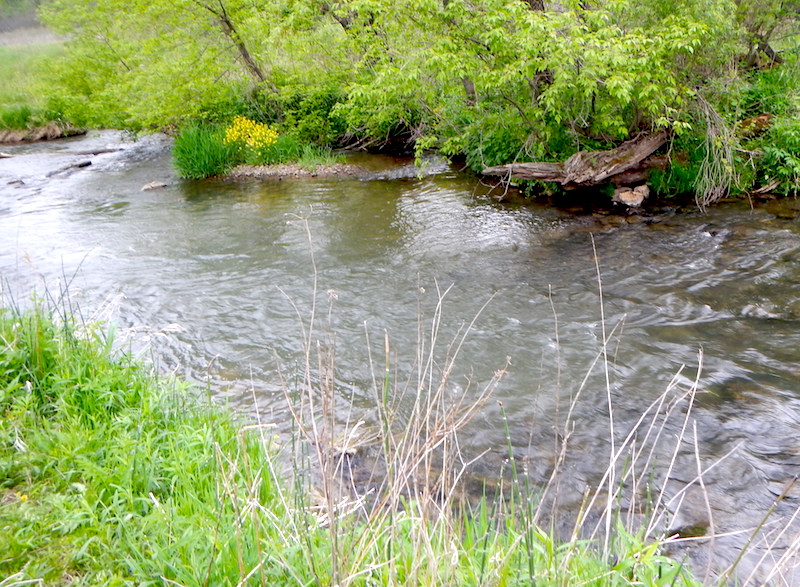
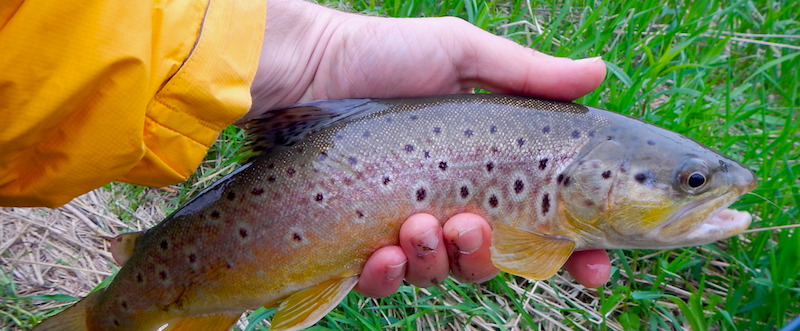
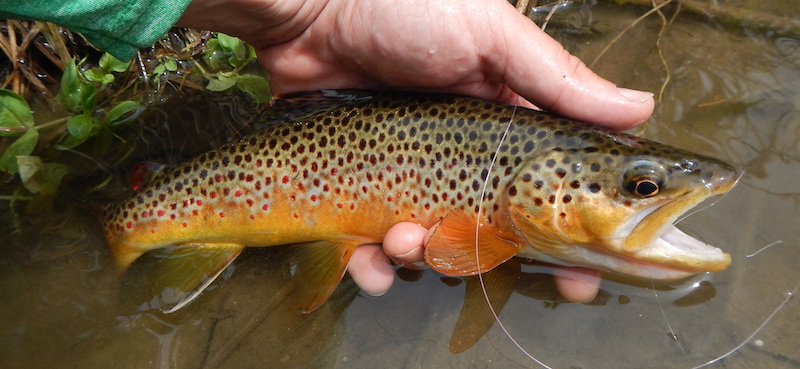
Below is a picture of nice deep pool fed by a riffle that I fished from this upstream casting position. I was able to coax several nice browns from the deep water with a swinging Pass Lake.
I wrote a blog piece a little while back on doing a basic wet fly swing presentation with discussion and diagrams: Swinging Wetflies. So check that out for some ideas. I have added to and refined my technique a bit since then – and a down and across presentation is not the only one that I employ, but it’s a good place to start. I’ll be putting together a new blog post soon to share some other thoughts on fishing wet flies.
Tying the Pass Lake Wet Fly
If you hang around anglers you’ll learn that fly tyers have pretty big egos and they are always trying to “improve” the tried and true classics that have worked for decades (or even centuries). I have been guilty of this myself. I have gotten into the habit of tying the Pass Lake wet fly differently than the original. I have swapped out the chenille body for peacock herl, switched the calf tail wing to antron and moved the hackle in front of the wing. I’m making no claims that this is an “improved” Pass Lake. I will only say that it works for me. I do think that the antron wing is an improvement at least in that it’s much easier to work with than calf tail. That said this year I plan on trying the original version again to see how it compares. The photo at the beginning of this post shows a more traditional Pass Lake with a chenille body and calf tail wing.
Step by Step for the APN Pass Lake Special Wet Fly
APN Pass Lake Special Wet Fly Recipe:
Body: Peacock Herl (originally black chenille)
Hackle: Brown Hen Hackle
Tail: Golden pheasant tippets – though I’ve used mallard flank or brown hackle fibers as alternatives.
Wing: White Antron (originally white calf tail)
Thread: Black
Hook: I prefer a heavy wire wet fly or nymph hook. I mostly use size 10, 12 and 14.
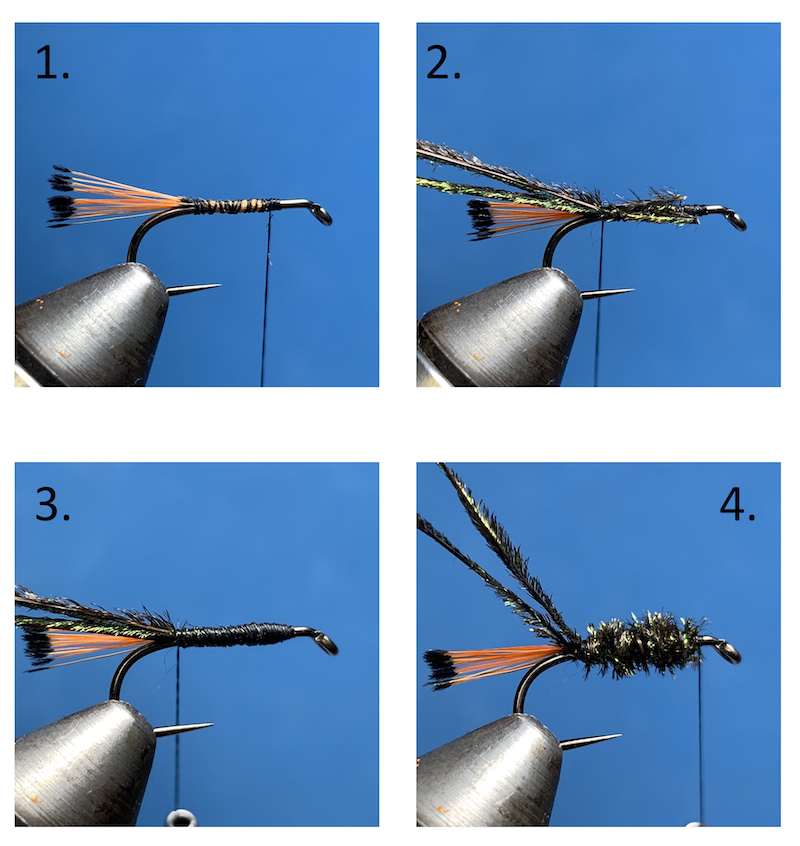
1. Tie tail fibers in as show then bring thread back to tie in point
2. Tie in 2 or 3 peacock herl strands at bend of hook as shown
3. If desired use thread to create a tapered underbody. I suspect that trout don’t give a hoot, but I think it looks nice.
4. Wind herl forward toward eye as shown then back over itself toward the tie in point. Then rib the herl with thread as you wind thread back toward the eye to the point shown. This method produces a nice reinforced body without the extra step and material of tying in a wire rib. Trim butt-ends of herl
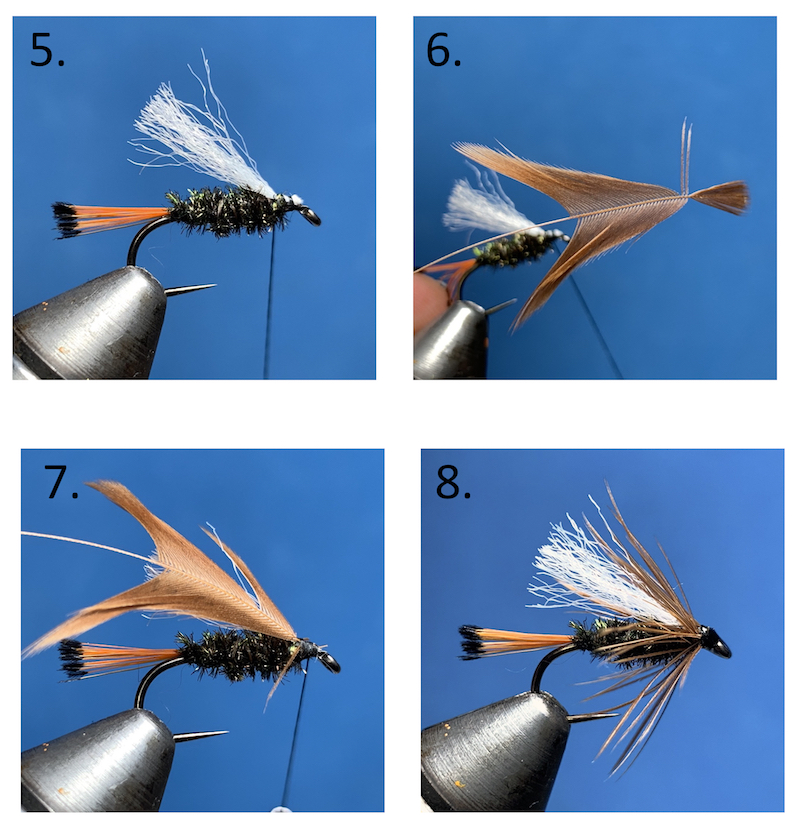
5. Tie in antron wing, trim to length as shown and trim butt-ends.
6. Prepare hen feather to tie in by tip by sweeping fibers back to create tie in point as shown in the picture
7. Tie in the hen hackle with concave side down
8. Wrap 2-3 turns of hackle, tie off hackle, trim then finish with a small head, whip finish and head cement.



 Casting Around
Leave a reply to Carl D Anderson Cancel reply